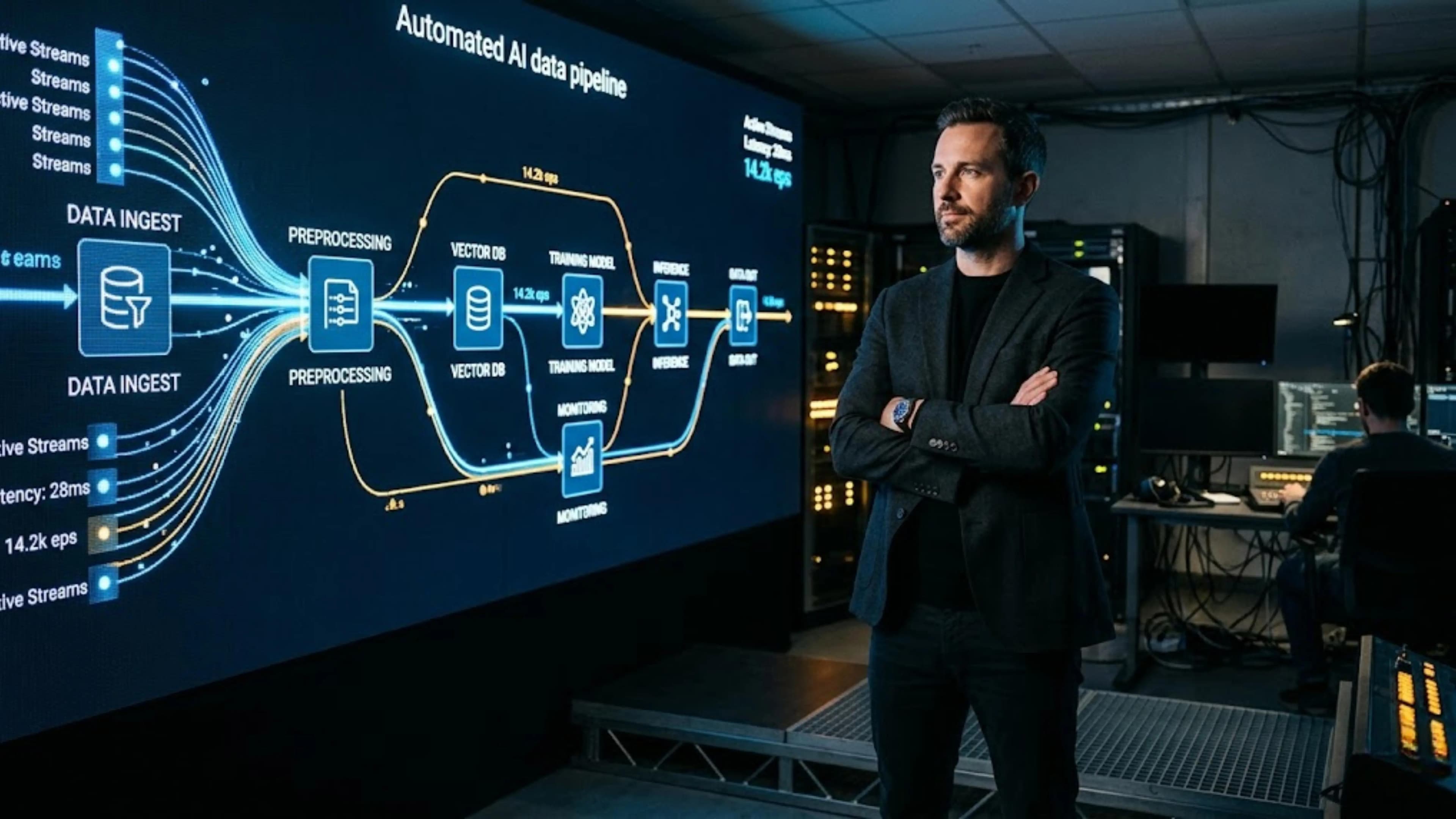
AI Is Not Coming. It's Already Here.
Not long ago, artificial intelligence was something you'd see in a sci-fi movie or read about in a tech magazine. It felt distant, theoretical, and honestly a bit overhyped.
That perception has aged badly.
Right now, businesses across every industry are using AI to cut costs, serve customers better, make faster decisions, and build products that would have been impossible to build a few years ago. The companies embracing it are pulling ahead. The ones waiting for the right moment are falling behind, often without realizing it yet.
This isn't about replacing people with robots. It's about understanding what AI actually does well, where it fits into how businesses operate, and how to use it without losing what makes your business worth coming back to.
Here's what's actually happening and why it matters.
1. Generic AI Is Being Replaced by AI Built for Specific Jobs
Early AI tools were broad and general. You could ask them questions, generate some text, maybe summarize a document. Useful, but limited.
What's happening now is more interesting. Businesses are building and deploying AI models trained specifically for their industry, their data, and their workflows.
A logistics company isn't using a general chatbot to manage its supply chain. It's using a model trained on its own operational data that understands the specific patterns, variables, and constraints of its business. A healthcare provider isn't relying on generic text generation for clinical documentation. It's using tools built specifically for medical contexts with the appropriate compliance requirements built in.
This shift toward customization means AI is becoming genuinely useful in ways that broad tools simply aren't. The businesses that figure out where AI can be trained and deployed for their specific context are going to have a meaningful edge.
2. Personalization at Scale Is No Longer Only for Big Companies
For a long time, personalized customer experiences were largely the territory of companies with massive data teams and equally massive budgets. Small and mid-sized businesses could acknowledge it as best practice but struggle to actually implement it.
AI has changed that equation significantly.
Tools that analyze customer behavior, purchase history, browsing patterns, and engagement data can now surface meaningful personalization without requiring a team of data scientists to run them. Personalized email sequences, product recommendations, dynamic website content, targeted follow-ups based on where someone is in the buying journey.
What used to take months of engineering and analysis can now be set up and running in days. For smaller businesses especially, this is a real leveler.
3. The Small Interactions Are Becoming Much Better
There's a category of digital experience that often gets overlooked because it doesn't feel significant in isolation. The confirmation message after a purchase. The progress indicator on a form. The chatbot that actually understands what you're asking instead of looping you through a menu.
These small interactions, sometimes called micro interactions, shape how people feel about using your product or visiting your site. When they're clunky or generic, they create friction. When they're smooth and responsive, they build a sense of quality and care that people notice even if they can't articulate why.
AI is making it much easier to build these interactions well. Chatbots that hold context across a conversation. On boarding flows that adapt based on how a user responds. Support experiences that feel like a person is paying attention.
The cumulative effect on customer satisfaction and retention is bigger than most businesses expect.
4. Accessibility Is Finally Getting Serious Attention
This one doesn't get talked about enough in business contexts, but it should.
A significant portion of the population navigates the internet with some form of disability. Visual impairments, hearing loss, cognitive differences, motor limitations. Historically, digital accessibility was either an afterthought or treated purely as a compliance checkbox.
AI is changing what's possible here in a practical way. Automated image descriptions that are actually accurate. Real-time captions for video content. Voice navigation that works without frustrating detours. Screen reader compatibility that doesn't break every time a site is updated.
Beyond the ethical dimension, accessible digital products reach more people. That's a business argument as much as it is a moral one.
5. Processing Is Moving Closer to Where the Data Is
Here's a technical shift that has real business implications.
Traditionally, AI processing happened in centralized cloud servers. Your device or application would send data to a server, the server would process it, and send a result back. That works fine in many cases, but it creates latency and raises privacy concerns, particularly when sensitive data is involved.
Edge AI changes this by moving the processing onto the device or closer to the data source. A security camera that analyzes footage locally instead of streaming everything to a server. A medical device that processes patient data on-site rather than sending it to a cloud system. A manufacturing sensor that detects anomalies in real time without waiting on a remote server to respond.
The benefits are faster response times, lower bandwidth costs, and stronger data privacy. For industries where real-time decisions and data security are critical, this shift is significant.
6. AI-Generated Content Is Useful and Needs to Be Handled Carefully
AI can now write, design, generate images, produce video, and create audio that ranges from clearly synthetic to nearly indistinguishable from human-made content.
For businesses, this opens up real opportunities. Marketing content produced faster. Product visuals generated without a full photo shoot. Customer-facing materials adapted for different audiences and formats without starting from scratch each time.
But it also comes with responsibility. Audiences are getting better at detecting low-quality AI-generated content, and the trust cost of getting that wrong is real. Deepfakes and AI-generated misinformation are genuine concerns that affect how people view AI-generated content broadly.
The businesses that use these tools well are the ones applying human judgment to what gets produced and published. AI as a capable assistant, not an unreviewed content machine.
7. Collaborative AI Training Without Sharing Sensitive Data
Federated learning is a technical concept worth understanding at a high level because the business implications are meaningful.
It's a way of training AI models across multiple devices or organizations without any of those parties having to share their raw data with a central system. Each participant trains the model locally on their own data. Only the model updates, not the underlying data, get shared and combined.
For industries where data sharing is legally restricted or commercially sensitive, this opens up possibilities for AI collaboration that weren't previously possible. Healthcare institutions sharing insights from patient data without sharing actual patient records. Financial organizations improving fraud detection models collectively without exposing customer information.
It's one of the more thoughtful solutions to the tension between the value of shared data and the need to protect it.
8. AI That Understands More Than Just Text
Early AI tools were largely built around language. You typed something in, you got text back.
The newer generation of AI systems is multimodal, meaning they can process and reason across multiple types of input simultaneously. Text, images, audio, and video all together rather than in isolation.
For a doctor reviewing a case, this means an AI that can analyze written notes, lab results, and medical imaging at the same time and surface insights across all of them together. For a retailer, it means a customer support system that can look at a photo of a damaged product, read the order history, and handle the return without needing a human to step in.
The applications across industries are broad and most of them are still being discovered.
9. AI as an Operational Layer, Not Just a Tool
There's a meaningful difference between using an AI tool occasionally and building AI into how your operation actually runs.
The businesses seeing the most significant results from AI aren't just using it for one-off tasks. They're integrating it into workflows so that it's working continuously. Automating data entry, routing customer inquiries, flagging anomalies in financial data, generating first drafts of reports, monitoring systems for issues before they become problems.
Digital twin technology sits at the more advanced end of this. It involves creating a virtual replica of a physical system, a factory floor, a supply chain, a building, and using AI to simulate scenarios and predict outcomes before making real-world decisions. The operational intelligence you get from that kind of modeling is hard to replicate any other way.
10. Ethical AI Is Not Optional Anymore
As AI becomes more embedded in how businesses operate, the decisions these systems make affect real people in real ways. Hiring decisions. Loan approvals. Content moderation. Medical diagnoses. Pricing.
The standards being applied to these systems, both by regulators and by the public, are rising. Bias in training data produces biased outputs. Lack of transparency in automated decisions creates accountability gaps. Poorly governed AI systems cause harm and generate significant legal and reputational risk.
Businesses that treat ethical AI as a compliance exercise to be handled later are going to find themselves on the wrong side of both regulation and public trust. Building with transparency, fairness, and accountability in mind from the start is not just the right thing to do. It's the smarter long-term approach.
What This Means for Your Business
You don't need to implement every trend on this list. The businesses that make AI work for them are not the ones chasing every new development. They're the ones that identify where AI solves a real problem in their specific context and implement it properly.
That requires clarity about what your business actually needs, honest assessment of what you're currently doing that could be done better or faster, and the right technical partner to build and integrate these solutions without cutting corners.
Innomactic Helps Businesses Get AI Right
At Innomactic, we work with businesses to figure out where AI fits, what's worth building, and how to implement it in a way that actually delivers results rather than just adding complexity.
Whether you're starting from scratch or looking to take what you've already built further, we'd rather have an honest conversation about what makes sense for your situation than pitch you a solution before we understand your problem.